Jalapeño Jelly Recipe
I love the sweet and spicy kick of jalapeño jelly, especially spooned over cream cheese or tucked into a sandwich. This version keeps little pieces of pepper for texture, with apple cider vinegar balancing the generous amount of sugar.
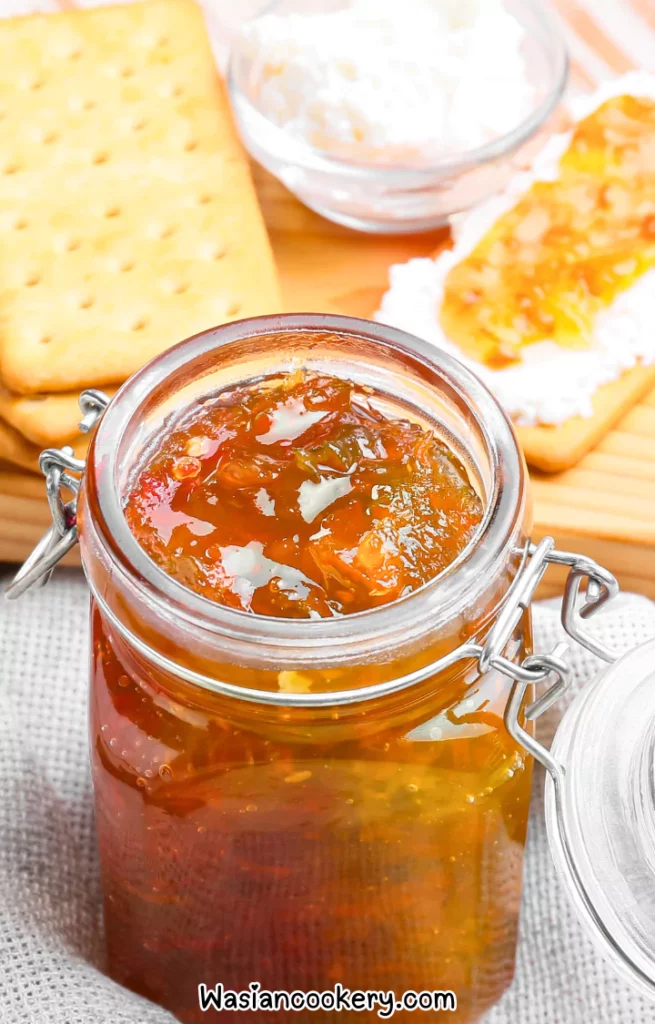
Treat this recipe as a fresh refrigerator spread. The ingredient proportions have not been validated for canning, and the finished texture may be soft or pourable. A tight lid, a firm set, or a bright green color does not make it suitable for pantry storage.
Make the batch when you have a few ways to use it over the next several days, or freeze small portions after cooling. Keep the measured ingredients as written, including the liquid pectin, and give the spread time to chill before deciding how to serve it.
Why This Dish Is Great
- Jalapeños provide a lively pepper flavor that stands out against the sugar.
- Green bell peppers soften the flavor and give the spread a little more body.
- Apple cider vinegar adds a tangy note that works with creamy cheese and savory meals.
- Finely chopped peppers give a rustic texture without a straining step.
- A spoonful can dress up an ordinary sandwich or a simple plate of crackers.
- A loose batch still has a use as a sauce, so you do not need to keep boiling in pursuit of a firm jelly.
What Are the Best Jalapeños to Use?
Choose fresh, firm jalapeños with smooth skins and no soft or moldy spots. The recipe calls for 12 large peppers, but large is not an exact weight, so the amount of prepared pepper can vary. That variation is one reason the finished volume and set cannot be promised precisely. Use the stated number rather than adding extra peppers to fill a particular jar.
Pepper heat also varies. Remove the stems, seeds, and pale inner membranes for a gentler result, remembering that jalapeños can still be spicy. Wear food-safe gloves while cutting them, avoid touching your face, and wash the knife and board afterward. The green bell peppers should feel firm and have crisp flesh rather than wrinkled, soft sides.
Ingredients
- 12 large jalapeño peppers, seeds removed and finely chopped
- 2 green bell peppers, finely chopped
- 1 ½ cups apple cider vinegar
- 6 cups sugar
- 1 pouch (3 oz) liquid pectin
- 1 teaspoon green food coloring (optional)
Use commercially bottled apple cider vinegar labeled 5% acidity and ordinary liquid pectin in the stated 3-ounce pouch. Those choices do not validate this recipe for canning. Powdered, low-sugar, and liquid pectins work differently, so do not swap them by spoonfuls. The optional green coloring changes appearance only; the spread also works without it.
Kitchen Equipment You Will Need
As an Amazon Associate I earn from qualifying purchases.
- Food-safe gloves
- Chef’s knife
- Cutting board
- Food processor
- Measuring cups
- Measuring spoons
- Large heavy stainless steel pot
- Long-handled heatproof spoon
- Timer
- Ladle
- Oven mitts
- Shallow heat-safe storage containers
- Refrigerator thermometer
- Small serving spoon
- Small serving bowls
- Freezer-safe containers
How To Make Jalapeño Jelly
- Wash the peppers thoroughly, remove the stems and seeds, and finely chop the jalapeños and green bell peppers. Remove the jalapeño membranes if you want less heat. Wear gloves. A food processor can help, but use short pulses and stop before the peppers become a puree.
- Put all the chopped peppers, apple cider vinegar, and sugar into a large heavy pot with plenty of room for bubbling. Heat over medium-high heat, stirring constantly until the sugar dissolves and the mixture reaches a rolling boil that continues while you stir. Reduce the heat slightly if it threatens to foam over.
- Stir in the entire 3-ounce pouch of liquid pectin. Bring back to a full rolling boil and boil for 1 minute, stirring constantly and timing from the return to the boil. This is a cooking step for a refrigerator spread, not a canning process or a guarantee of a firm set.
- Remove the pot from the heat. Skim off surface foam with the spoon if desired, then stir in the optional green food coloring. Keep your face and hands away from the steam; hot sugary liquid can burn. Do not add water or taste the mixture while it is hot.
- Carefully ladle the mixture into several clean, shallow, heat-safe containers. Refrigerate promptly at 40°F or below, within 2 hours of cooking or 1 hour if the room is above 90°F. Do not leave the entire pot on the counter until cold, and do not hot-fill and seal jars for pantry storage.
- Keep all containers refrigerated and allow about 24 hours before assessing the final texture. The spread may remain soft or pourable; use a loose batch as a sauce. Use within 3–4 days of preparation or freeze small portions promptly after chilling. This recipe is not suitable for water-bath canning, even if a lid pulls down as it cools.
Allow about 20 minutes for preparation and approximately 15 minutes on the stove, including heating to the boil. The card total of 24 hours 35 minutes includes a full day of refrigerator chilling before the final texture check. Heating and cooling vary with the pot and container depth; this timing does not promise that the spread will become firm.
The yield is one batch, with the finished volume depending on pepper size and evaporation. Have several small containers ready instead of relying on an exact cup count. Do not reduce the mixture aggressively to force it into a certain number of jars; that can concentrate the sugar and give a sticky result.
Notes
- Read the pectin label before opening it so you know you have ordinary liquid pectin, not a different type with a different method.
- Measure all the sugar before heating the pot. Stopping halfway through to refill a cup makes the hot stage harder to manage.
- Chop the pepper pieces fairly evenly so one spoonful is not full of large chunks while another contains only syrup.
- Use a pot with ample headroom. A bubbling sugar mixture needs more space than the cold ingredients suggest.
- Stir across the bottom and into the corners of the pot to reduce sticking while the sugar dissolves.
- Skimming foam is optional for appearance. Foam, clarity, color, and a chilled-plate test cannot tell you whether a recipe is safe to store unrefrigerated.
- Chill first before judging thickness. Do not keep adding pectin or boiling repeatedly; a pourable spread can be served in small spoonfuls.
Ingredients You Can Add
Add these only to a small portion immediately before serving, leaving the stored batch unchanged. They are ways to vary a snack, not adjustments to a canning formula.
- Cream cheese makes a mild, creamy base for a spoonful of spread.
- Chopped cilantro adds a fresh herbal note to a savory serving.
- A pinch of crushed red pepper gives extra heat to an individual portion.
- Chopped toasted pecans add crunch beside the sweet peppers.
- A little mustard mixed into a serving makes a tangy sandwich condiment.
- Thinly sliced scallions give a sharper finish over a cheese-topped cracker.
What To Serve With Jalapeño Jelly
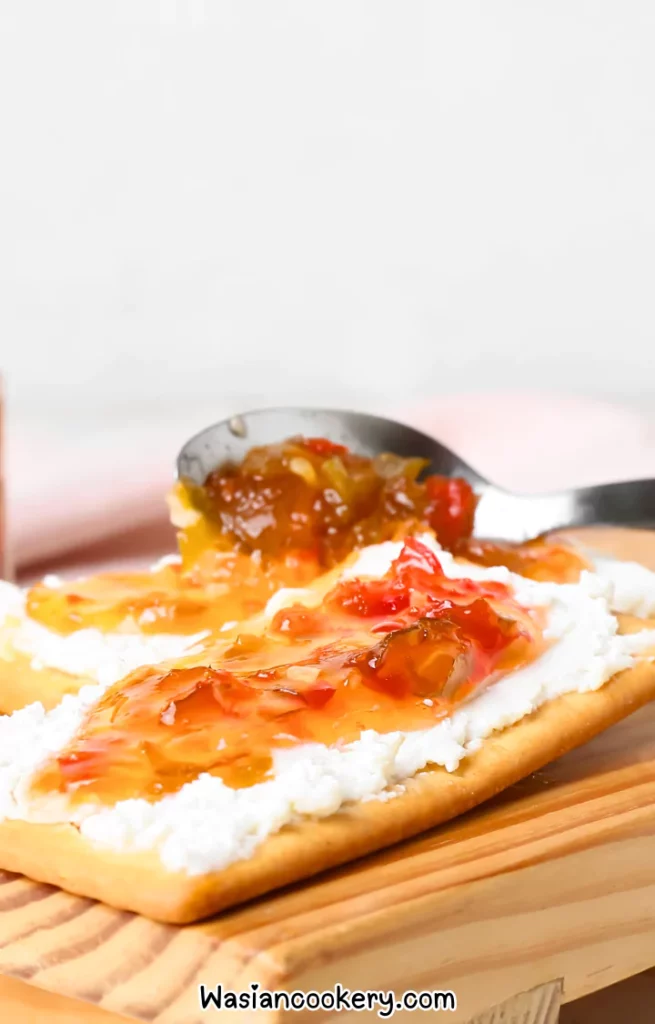
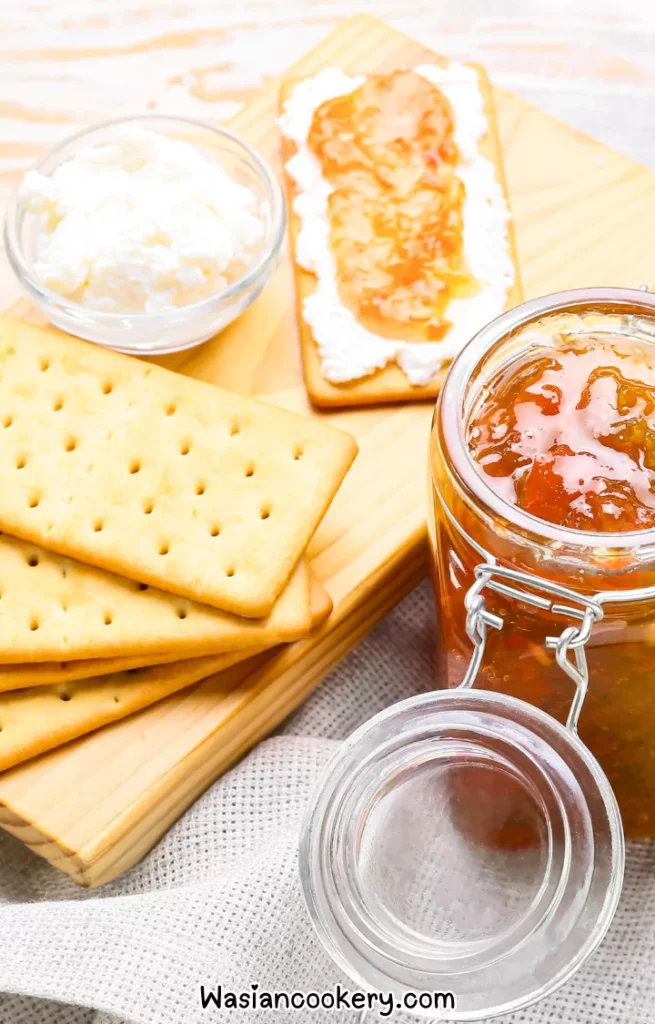
Cream cheese and crackers are the easiest place to start. Spoon a little spread over the cheese and let everyone add more to taste. For a more filling plate, offer pieces of Yats bread alongside, keeping the spicy topping separate for anyone who prefers a milder bite.
A small amount also works as a sandwich spread. Try it with slices of homemade sandwich bread, cheese, and crisp vegetables. Spread it thinly so the bread does not become soggy, especially when your batch has a looser texture.
For a savory dinner, offer it as a table condiment with a turkey burger. Put only the portion you need into a serving bowl and keep the rest cold. If using it with cooked meat, keep any spoon that touched raw meat away from the storage container.
Variations and Swaps
- Omit the optional food coloring for the natural color of the cooked peppers.
- Remove the jalapeño membranes along with the seeds for a milder batch, while keeping all 12 peppers.
- Keep more of the membranes if you enjoy heat; individual peppers still vary.
- Chop by hand for more control over the size of the pepper pieces.
- Pulse briefly in a food processor when you prefer a finer texture, without turning the mixture into juice.
- Serve a soft batch as a spoonable topping for cheese rather than expecting a sliceable jelly.
- Use a pourable batch as a cold sandwich sauce in small amounts.
- Choose a separate complete recipe if you need reduced sugar, another pectin type, or a shelf-stable preserve. Those changes need their own formula.
Storage
Refrigerate every container at 40°F or below, whether it has been opened or not. Use within 3–4 days of preparation; this is a conservative fresh-food limit, not a tested extended jelly shelf life. Use a clean serving spoon each time. Discard any batch left unrefrigerated beyond the cooling window, and do not taste it to check safety.
For longer keeping, freeze small chilled portions in freezer-safe containers, leaving expansion space as the container manufacturer directs. Use within about 1 month for best quality, thaw in the refrigerator, and use promptly. Freezing may change the texture. Discard the whole container if it develops mold, fermentation, or other spoilage; removing only the top layer is not enough.
FAQ
Can I store a sealed jar in the pantry?
No. This recipe has no validated canning process. A sealed lid does not establish safe preservation, so every container needs refrigeration. Do not add a guessed water-bath time to these instructions.
Why did my spread stay runny?
The pepper quantity varies by size, and pectin depends on the balance of the whole formula. After chilling, use a loose batch as a sauce. There is no need to force a firm set by adding unmeasured pectin.
Can I replace liquid pectin with powder?
No direct swap is reliable. The ingredient amounts and order of adding sugar and pectin can differ. Use the listed liquid pectin here, or start with a complete recipe designed for your pectin.
Can I reduce the sugar?
Keep the listed amount for this version. Reducing it changes both sweetness and how ordinary pectin behaves. A lower-sugar spread needs its own complete formula rather than an improvised adjustment to this batch.
Do I have to sterilize storage jars?
Use thoroughly cleaned, heat-safe containers and lids. This is a refrigerated food, and sterilizing jars cannot turn it into a shelf-stable preserve. Shallow containers help the hot mixture cool more readily.
Can I use dried peppers?
Use fresh peppers as listed. Dried peppers have different moisture and texture, and substituting them would change the formula. A separate recipe is a better choice when dried peppers are what you have.
Short Description
A sweet, spicy jalapeño and green bell pepper refrigerator spread with apple cider vinegar and liquid pectin. Makes one variable-volume batch; the texture may remain soft or pourable. Not for canning.
Jalapeño Jelly Recipe
Course: AppetizersCuisine: AmericanDifficulty: Easy1
batch20
minutes15
minutes24
hours35
minutesA sweet, spicy jalapeño and green bell pepper refrigerator spread with apple cider vinegar and liquid pectin. Makes one variable-volume batch; the texture may remain soft or pourable. Not for canning.
Ingredients
12 large jalapeño peppers, seeds removed and finely chopped
2 green bell peppers, finely chopped
1 ½ cups apple cider vinegar
6 cups sugar
1 pouch (3 oz) liquid pectin
1 teaspoon green food coloring (optional)
Directions
- Wash the peppers thoroughly, remove the stems and seeds, and finely chop the jalapeños and green bell peppers. Remove the jalapeño membranes if you want less heat. Wear gloves. A food processor can help, but use short pulses and stop before the peppers become a puree.
- Put all the chopped peppers, apple cider vinegar, and sugar into a large heavy pot with plenty of room for bubbling. Heat over medium-high heat, stirring constantly until the sugar dissolves and the mixture reaches a rolling boil that continues while you stir. Reduce the heat slightly if it threatens to foam over.
- Stir in the entire 3-ounce pouch of liquid pectin. Bring back to a full rolling boil and boil for 1 minute, stirring constantly and timing from the return to the boil. This is a cooking step for a refrigerator spread, not a canning process or a guarantee of a firm set.
- Remove the pot from the heat. Skim off surface foam with the spoon if desired, then stir in the optional green food coloring. Keep your face and hands away from the steam; hot sugary liquid can burn. Do not add water or taste the mixture while it is hot.
- Carefully ladle the mixture into several clean, shallow, heat-safe containers. Refrigerate promptly at 40°F or below, within 2 hours of cooking or 1 hour if the room is above 90°F. Do not leave the entire pot on the counter until cold, and do not hot-fill and seal jars for pantry storage.
- Keep all containers refrigerated and allow about 24 hours before assessing the final texture. The spread may remain soft or pourable; use a loose batch as a sauce. Use within 3–4 days of preparation or freeze small portions promptly after chilling. This recipe is not suitable for water-bath canning, even if a lid pulls down as it cools.
Notes
- Refrigerator spread only; no validated canning process. A sealed lid does not make the recipe shelf-stable.
- Refrigerate promptly in shallow heat-safe containers at 40°F or below, within 2 hours of cooking or 1 hour above 90°F. Use within 3–4 days of preparation, a conservative fresh-food limit.
- Allow about 24 hours refrigerated before assessing final consistency; a firm set is not guaranteed. A loose batch can be used as a sauce.
- Yield is 1 batch. Pepper size and evaporation determine the finished volume; do not rely on an exact cup yield. The 24-hour 35-minute total includes chilling.
- Preserve the listed ingredient amounts and use the specified liquid pectin. Do not substitute powdered or reduced-sugar pectin or improvise a canning process.